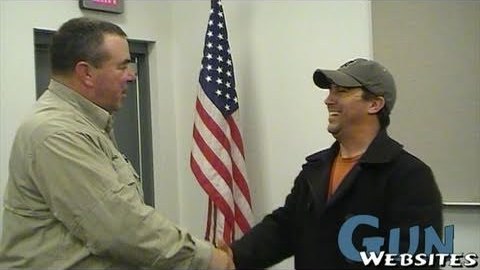
Few ideas in defensive shooting are quoted more often, or misunderstood more often, than the “21-foot rule.” Gun Websites caught up with Dennis Tueller at a Glock Armorer course in Cottonwood, Arizona, and asked him how it really started.
It began with a student’s question
- In the early 1980s, Tueller was running firearms training for the Salt Lake City Police Department.
- A student asked: at what point is someone armed with a knife or club close enough that deadly force is justified?
- Tueller realized he did not have a good answer, so the class went looking for one.
The experiment
- The class already knew roughly how long it took to draw and hit a target at seven yards, so seven yards became the test distance.
- One student played the attacker, another the officer, and instructors ran stopwatches from the start of the charge to contact.
- The result surprised everyone. The best the officer could hope for was a tie, and that was when the officer knew the attack was coming.
- Across a class of a couple of dozen recruits, young and older, men and women, the times were remarkably consistent.
From article to drill
- Tueller wrote up the findings as “How Close Is Too Close?” in the March 1983 issue of SWAT magazine, encouraged by Chuck Taylor, then operations officer at Gunsite.
- Massad Ayoob built on the work in later articles and training, named it the Tueller principle and the Tueller Drill, and credited Tueller with the idea.
There is nothing magic about 21 feet
- Twenty-one feet came from the seven-yard baseline in the original study. It was never meant to be a rule.
- The real concept is the reactionary gap, and it changes with your skill, your gear and the situation.
- If you can draw and fire in under two seconds, 20 to 25 feet is a reasonable gap. If you carry deep and need several seconds to clear clothing or a purse, an attacker 40, 50 or 60 feet away can reach you first.
- Multiple attackers need more distance and more rounds.
- At conversation distance, blocking or disarming may be the better option, because a draw cannot win once the attacker has started.
What to do with it
- Time your own draw from the way you actually carry. That number sets your reactionary gap.
- If you see a threat in time, draw, cover and issue a verbal challenge.
- Use obstacles. Tables, chairs and trash cans that slow an attacker buy time to react.
From Salt Lake to Glock
- Tueller spent 25 years with Salt Lake City PD, trained at Gunsite in its early classes and taught there part time under Jeff Cooper.
- His department tested early Glocks, could barely make them fail, and adopted them as the issue pistol. After retiring he worked at Action Target and the Department of Energy’s National Training Center before joining Glock as a regional trainer.
Try it
- Run the Tueller Drill with a partner and a timer, and read more about Dennis Tueller on the Firearm Instructors page.
- See the Glock Armorer report from the same course.
Based on a video from the Gun Websites YouTube channel. Take a class, write your after action report, and keep it in your training log.