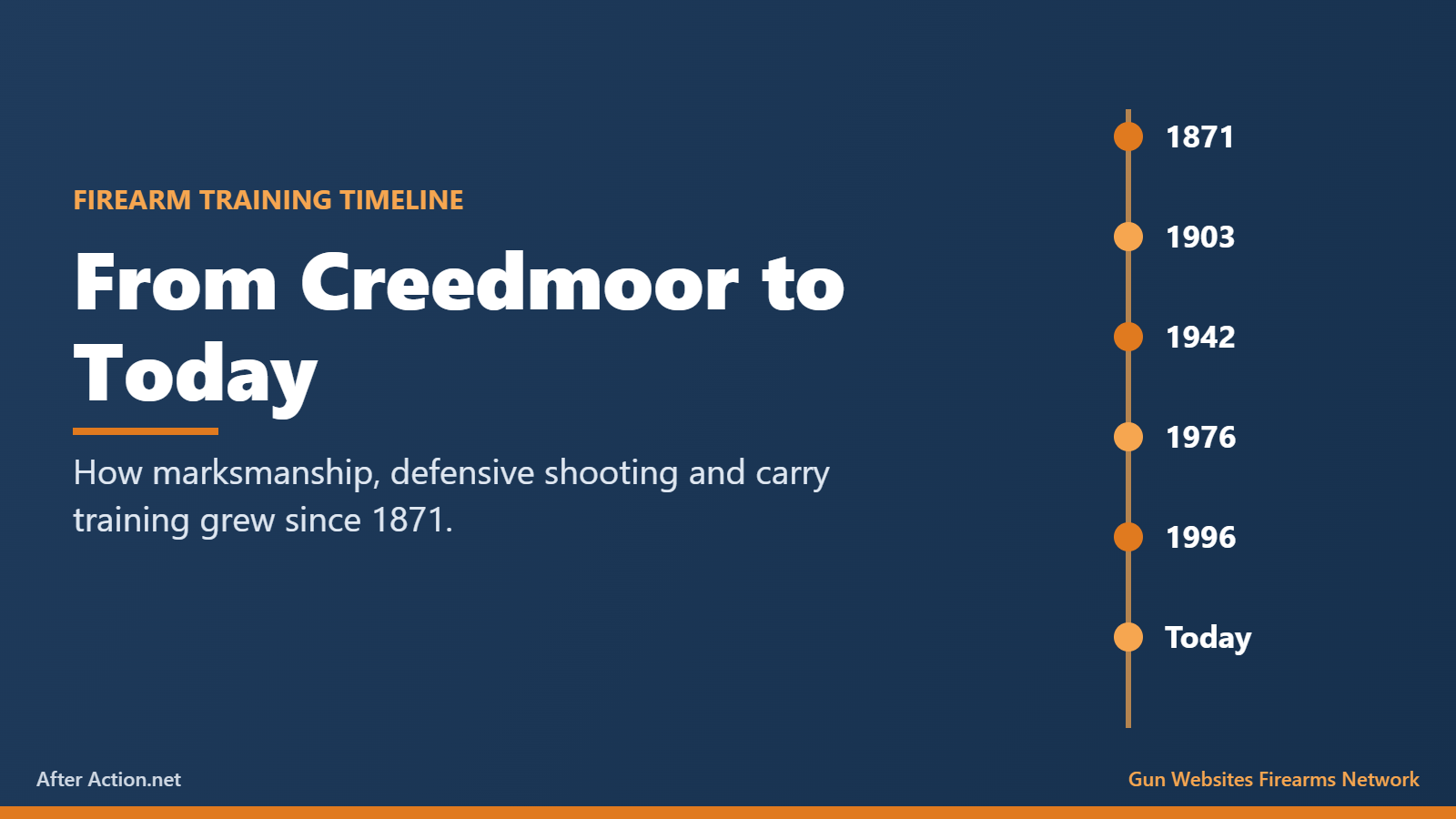
Firearm training in America runs from the Creedmoor rifle range of 1873 to the instructors and carry classes of today. This timeline marks 47 milestones: the organizations, schools, books, matches, laws and hard lessons that shaped how shooters train.
Union veterans William Conant Church and George Wood Wingate charter the National Rifle Association in New York to improve marksmanship after poor shooting seen in the Civil War.
The NRA's Creedmoor range on Long Island opens and becomes the center of American long-range rifle training and international matches.
Congress creates the National Board for the Promotion of Rifle Practice (forerunner of the CMP), and the first National Matches are fired at Sea Girt, New Jersey.
William E. Fairbairn begins the police career where he developed close-combat and point-shooting methods.
After an NRA survey found few large cities trained officers with firearms, a Special Police School is set up at Camp Perry, Ohio, with the Hogan's Alley course of fire created for it.
Ed McGivern fires five double-action shots into a hand-sized group in 2/5 of a second.
The FBI creates its National Police Training School (later the FBI National Academy) and establishes a presence at Quantico, including firearms training for newly armed agents.
Ed McGivern publishes his study of speed revolver shooting, still read by instructors today.
Fairbairn and Sykes publish their point-shooting text based on Shanghai police gunfights.
Rex Applegate publishes the close-combat manual that shaped wartime and police training.
New York launches the first state hunter safety program, with the NRA designated to develop and run the course, a model later copied nationwide.
Jeff Cooper's Big Bear Leatherslap draw-and-shoot matches begin in California; the Bear Valley Gunslingers group later grows into the Southwest Combat Pistol League, the testing ground of the Modern Technique.
The NRA begins certifying law enforcement officers as NRA Police Firearms Instructors.
John Boyd writes the first manual on jet air combat; his later OODA loop entered firearms training.
The NRA takes on the National Police Championships and develops Police Pistol Combat (PPC) competition.
Four CHP officers are killed in Newhall, California, prompting a shift toward street-survival training, cover use, moving targets and revised reloading and felony-stop tactics.
The first class begins training at the new FBI Academy campus at Quantico, Virginia.
Practical shooters from several countries meet in Columbia, Missouri, and found the International Practical Shooting Confederation.
Jeff Cooper establishes the American Pistol Institute near Paulden, Arizona, later known as Gunsite Academy.
John Bianchi, with Ray Chapman and Richard Nichols, creates the Bianchi Cup action pistol championship in Missouri.
Massad Ayoob publishes his landmark book on the law and use of deadly force.
Mike Dalton and Mike Fichman found the Steel Challenge speed-shooting match.
Massad Ayoob begins directing the Lethal Force Institute, training armed citizens and police until 2009.
Dennis Tueller publishes "How Close Is Too Close?" in SWAT magazine, the source of the 21-foot rule.
The United States Practical Shooting Association is incorporated as the US region of IPSC.
A deadly gunfight in Pinecrest, Florida, leads the Bureau to drop revolvers, add MP5s for high-risk work and adopt the 10mm, later the .40 S&W.
Florida enacts a shall-issue concealed weapon license law that other states soon followed, creating wide demand for carry-permit classes.
Louis Awerbuck opens his school in Prescott Valley, Arizona.
Pat Rogers begins running E.A.G. Tactical, which set the standard for AR-15 carbine courses.
Clint Smith's Thunder Ranch opens as a civilian and professional firearms training facility; it later moved to Oregon in 2004.
The NRA begins its Refuse To Be A Victim program teaching personal safety and crime-avoidance strategies.
Bill Wilson, Ken Hackathorn, Walt Rauch, Larry Vickers and others found the International Defensive Pistol Association around practical, self-defense-oriented scenarios.
Ignatius Piazza founds the Front Sight Firearms Training Institute, later operating a large facility near Pahrump, Nevada.
Tom Givens opens the Rangemaster range and training operation in Memphis, Tennessee, known for documenting student defensive-encounter outcomes.
A Los Angeles bank robbery gunfight in which officers were outgunned accelerates the issue of AR-type patrol rifles and related training.
Tom Givens starts the annual conference that gathers top instructors in one place.
Alaska becomes the first state to adopt permitless concealed carry while still issuing optional permits.
Craig Douglas founds ShivWorks and its Extreme Close Quarter Concepts course.
After Action.net starts publishing after action reports from real training classes.
Rob Pincus founds I.C.E. Training and its Combat Focus Shooting program.
Marty Hayes founds the Network to support members after a self-defense incident.
Arizona's permitless carry law takes effect, making it the third state (after Vermont and Alaska) to allow concealed carry without a permit.
The women’s shooting league is founded; it grows to more than 300 chapters.
Rick Ector holds the first free women’s shooting lesson; more than 14,000 women trained since.
Ohio’s FASTER program begins training armed school staff.
Ken Hackathorn, Larry Vickers and other veteran trainers found a professional association for instructors.
The Supreme Court strikes down New York's proper-cause carry permit standard and sets a text-and-history test for gun laws.
Keep exploring
Meet the people behind these milestones in the Firearm Instructors directory, find a place to train in the Training Schools guide and on the Training Schools Map, and read real class reviews on the Course List.